Showing posts with label Project: Points. Show all posts

Thursday, 1 March 2012

Exercise seventeen: Multiple points

Drawing a conclusion to the points project and progressing from the previous 2 exercises, the aim here is to arrange a still life containing multiple points. Although it sounds simple, the challenge is doing so without it appearing obvious or creating strong shapes - the more points, the greater levels of complexity. I  rearranged the selection several times before settling on the following arrangement.

35mm, 2 secs, f/25, ISO 400
With the background set there were a couple of decisions: which marble to use and where to put it.  With the light source over to the right I chose a position slightly off centre with the marble's shadow pointing in to the frame.

35mm, 2 secs, f/25, ISO 400
Of course, as we saw in the previous exercise, adding a second point creates a connection, a line. I placed it here to achieve a degree of balance.  The white marble is still the dominant point.

35mm, 2 secs, f/25, ISO 400
A third point introduces the prospect of a stronger line if all in a line, or a triangle. A line would have looked contrived so I created an obtuse (and weaker) triangle.

35mm, 2 secs, f/25, ISO 400
The fourth marble creates a small right angle triangle in the foreground. The extended line on the left hand side softens the appearance of the triangle and prevents the scene looking contrived.

35mm, 2 secs, f/25, ISO 400
My intent here was to soften the small triangle further. The result is a composition of two lines - one down the left hand side and a new one starting on the right running slightly diagonally upwards.
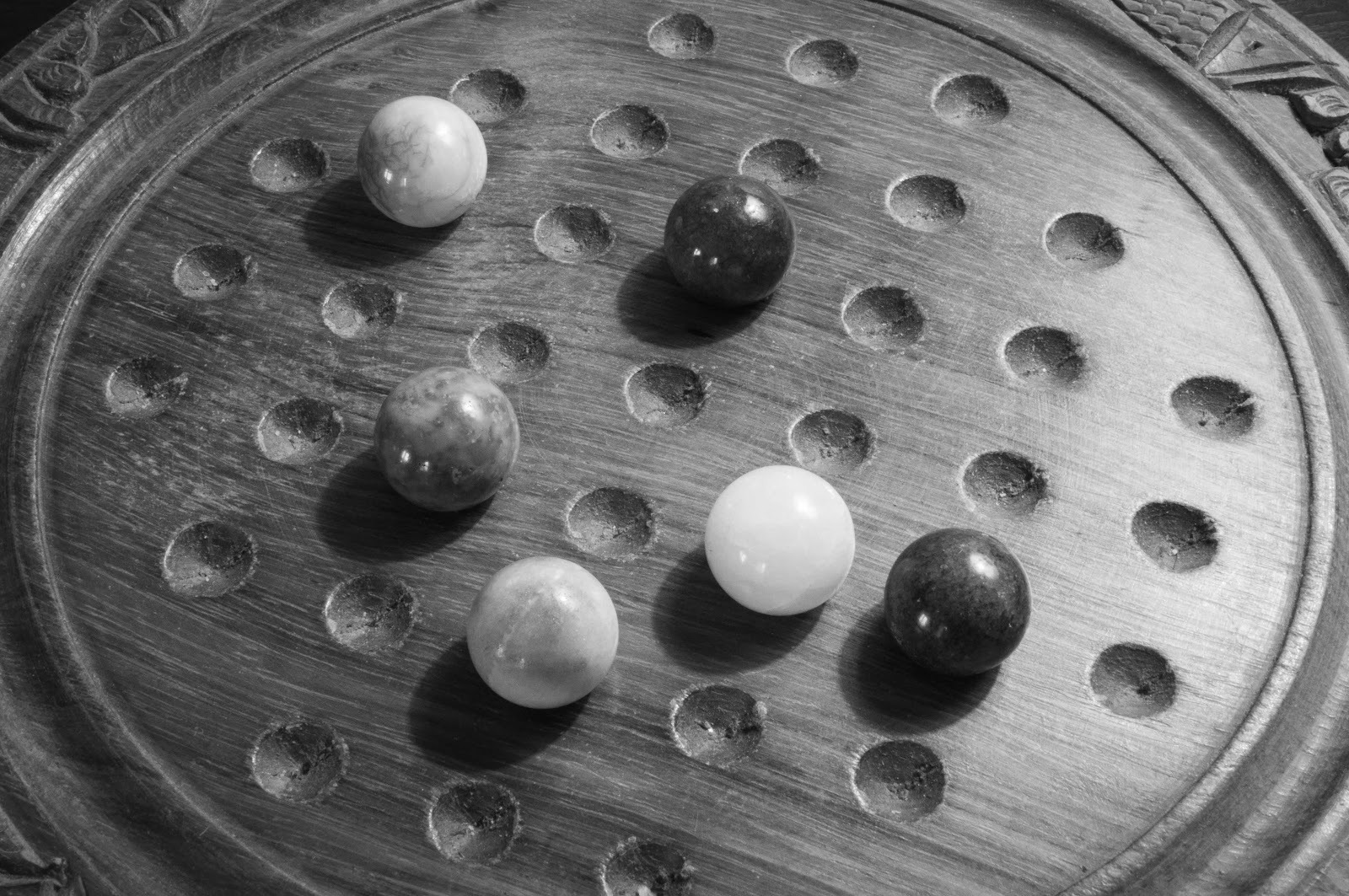
35mm, 2 secs, f/25, ISO 400 
With the last placement I wanted to avoid extending either of the lines - it would have looked contrived otherwise.

35mm, 2 secs, f/25, ISO 400
It wasn't until I overlaid the final image with lines did I understand how difficult it is to truly fit the brief. Triangles are such a powerful and recognisable shape and there are 3 of them of a similar size in the final shot. In hindsight choosing a solitaire board, with its regular pattern, makes it more difficult for an arrangement to feel random - and each point is uniform too.

The more I look at the final image, it's not the triangles I see - it's the diamond shape that occupies the centre.

In summary, I didn't make things easy for myself but I do feel that I have managed to avoid the rather easy pitfall of the image appearing obvious/contrived.

Exercise sixteen: The relationship between points

A single point depicts simplicity, yet that is lost once a second point is introduced to the frame.  The brief for this exercise was to capture 3 images containing 2 points. 

50mm, 1/160 secs, f/1.8, ISO 400
The dominant point is clearly the coffee mug for several reasons regardless of their similarity in size: the narrow depth of field renders tithe only thing in focus; it's brighter than anything else in the frame, and it conveys a message which compels the viewer to read.

50mm, 1/60 secs, f/1.8, ISO 800
You may have noticed the current obsession with my 50mm lens. Similar to the first shot, only one of the points in this image is in focus, yet the other child's shoe creates dynamic tension as it competes for the viewers attention because of it's irregular, more interesting position. The entire scene gives a sense of missing out on the fun that's happening elsewhere.

[Additional image and conclusion to follow]

Exercise fifteen: Positioning a point

The weather has been suspect to say the least so I've had little choice but to shoot for the following couple of exercises indoors.  The brief for this one was to capture 3 images containing a single point and compare and contrast them with the single point images previously identified.

50mm, 1/125 secs, f/1.8, ISO 400
This toy car dominates the frame far more than I expected, and even more so with the reflection. So instead of realising my intent to potion the subject on the upper left intersection of the rule of thirds, the eye (courtesy of the area in focus and its brightness) is drawn to the front wheel. Hence why I've drawn the red intersection through it.

I positioned it above the horizon to emphasise the reflection and to the left in order to imply movement into the frame. (See the images in the previous post of the fish and the rabbit.) The angle of the subject further accentuates this.

50mm, 1/60 secs, f/1.8, ISO 800
Upon conversion to black and white the illuminated Apple logo become the single point in this image. The rationale for positioning it lower right was for the subject to benefit form the natural light from the upper left. The upper left of the laptop, arrow-like in appearance, implies movement towards this light. (The bird of prey, small child and cider bottle images have similar qualities.)

50mm, 1/50 secs, f/1.8, ISO 400
Composition is restricted with this subject. Any closer and the eye dominates the frame and is no longer a point; any further to the left of the frame then a second point would be introduced (the other eye!).  The decision then rests with where to position the point on the vertical.  The upper part of the frame gives a greater sense of authority, amplified by the slight incline of the camera.

I must admit to thinking that this exercise was a mere repetition of the early exercise but I've noticed a growing sophistication, not only in my critique of images but my growing ability to to compose and capture them.

Sunday, 12 February 2012

Exercise fifteen preparation: Positioning a point

The brief for this exercise is to take 3 shots composed with just a single point. The point being the most fundamental design element of a photograph.

Firstly, I've brainstormed possible compositions that could contain a single point.  There are too many to list, so here are the highlights:
  • Graffiti on a wall
  • A distant shot of a golfer on the fairway
  • The moon in the night sky
  • A lone horse in a field
  • A person in the distance walking on the beach
In preparation for the exercise I've looked through my existing library of photos for examples of images that contain a single point. 


It's worth noting that I've realised that I don't have a natural tendency to compose images with a single point (as these are the only images that I have that fit the brief).

As the study material point out, I should avoid being drawn to images on the grounds of colour when completing this next section of the course.  The door handle is a case in point - the vivid blue alongside the green was my motive for taking the shot at the time.  So from here on in I'll be endeavouring to convert images to black and white.

Pages